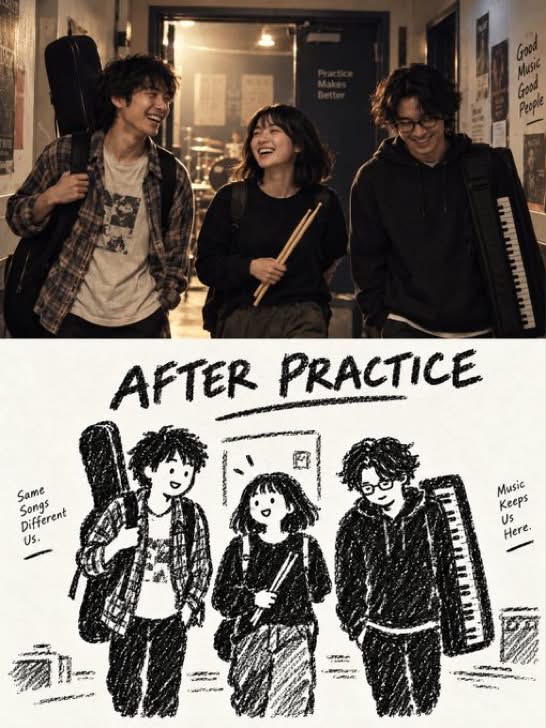
Editorial Photo and Crayon Illustration Poster
A professional editorial layout featuring a high-end photograph paired with a minimalist, hand-drawn black crayon illustration on cream paper.
Full Prompt · 100% Free568 words
Convert each uploaded photo into a single standalone high-end editorial design poster. Do not combine multiple photos into the same frame. Use a strict 3:4 vertical canvas, and divide the frame evenly from the horizontal direction into two completely equal upper and lower parts, each occupying 50%. Upper Half: Original Photo. Faithfully preserve all core information from the uploaded photo: Character identity, facial features, body proportions, posture, clothing, objects, composition, lighting, shadows, materials, and the original color atmosphere. Perform only subtle, advanced editorial-style color grading, without altering the authenticity of the photo itself. If the original photo's aspect ratio cannot fit the layout, naturally extend the background to fill the frame, but absolutely do not stretch, distort, deform, or redesign the characters or main subjects. Lower Half: Minimalist Black Crayon Illustration. Extract the most identifiable main subject, pose, character interactions, and narrative relationships from the original photo, and reinterpret them as a minimalist black-and-white illustration. Use a clean warm off-white / cream paper background for the frame. Simplify characters or subjects into rounded, heavy, slightly naive contours, while ensuring the main subject remains instantly recognizable. If the photo features multiple characters, retain their most important interactive relationships and present them as a complete visual whole. Use only black crayon, black charcoal, dry erase / dry brush-style stroke textures, and rough black marks on paper. Prohibit the use of any colors. Do not use realistic shadows or smooth vector fills. All black areas must be composed of rough, repeatedly overlaid hand-drawn strokes, and retain distinct paper grain texture, fractured edges, uneven black density, natural white space, slightly tremulous contours, and hand-drawn imperfections. Within large black shapes, boldly incorporate white negative space cutouts to highlight key features, such as character's face, eyes, animal's mouth and nose, windows, openings, and distinctive local details. Facial features need only minimal black dots or short lines for suggestion. Do not render realistic facial details. Lower Half Composition: The overall composition must be extremely concise and restrained. Retain ample white negative space. Highlight only one primary character relationship, action, or narrative connection. Minimize environmental elements. The background should use at most a few very simple, rough lines or symbols, such as ground line, grass, rain, smoke, road, wind, shadows, or a few objects. Do not fully render complex environments. Text Design: Based on the photo's mood, action, character relationships, and life story, automatically generate 1 short English title and 1–2 very small supporting English phrases. Use restrained editorial design fonts, combined with slightly clumsy, casual handwritten or crayon fonts. Text must naturally integrate into the illustration, rather than being placed separately like standard typesetting. Text can align along the ground line, be placed in large negative spaces, follow the direction of character actions, or slightly overlap or obscure the illustration. Overall Visual Aesthetic: The overall feel should evoke an old-era black-and-white children's picture book, republished by a high-end contemporary design studio. The frame should simultaneously convey quietness, warmth, a touch of humor, a touch of loneliness, tactile authenticity, childlike naivety, yet with a mature, advanced design sensibility. The final effect should fall between documentary photography, independent magazine editorial design, vintage children's picture books, black-and-white crayon sketches, and contemporary art publications. Avoid: smooth digital outlines, clean, orderly vector graphics, overly precise geometric shapes, realistic shadows, gradients, 3D effects, colored elements, large areas of gray wash effects, sticker-like graphics, standard commercial illustration style, and template-based poster design.
Interactive Prompt Remixer
Customize subject, lighting, or framing slots below — the prompt updates live while preserving proven camera syntax.
Convert each uploaded photo into a single standalone high-end editorial design poster. Do not combine multiple photos into the same frame. Use a strict 3:4 vertical canvas, and divide the frame evenly from the horizontal direction into two completely equal upper and lower parts, each occupying 50%. Upper Half: Original Photo. Faithfully preserve all core information from the uploaded photo: Character identity, facial features, body proportions, posture, clothing, objects, composition, lighting, shadows, materials, and the original color atmosphere. Perform only subtle, advanced editorial-style color grading, without altering the authenticity of the photo itself. If the original photo's aspect ratio cannot fit the layout, naturally extend the background to fill the frame, but absolutely do not stretch, distort, deform, or redesign the characters or main subjects. Lower Half: Minimalist Black Crayon Illustration. Extract the most identifiable main subject, pose, character interactions, and narrative relationships from the original photo, and reinterpret them as a minimalist black-and-white illustration. Use a clean warm off-white / cream paper background for the frame. Simplify chara
Compatible Models
How to Customize
Swap the subject, wardrobe, or color palette while keeping the lighting and camera phrasing intact. In Midjourney, add --ar 4:5 for portraits or --ar 16:9 for cinema frames.
Keep Exploring